


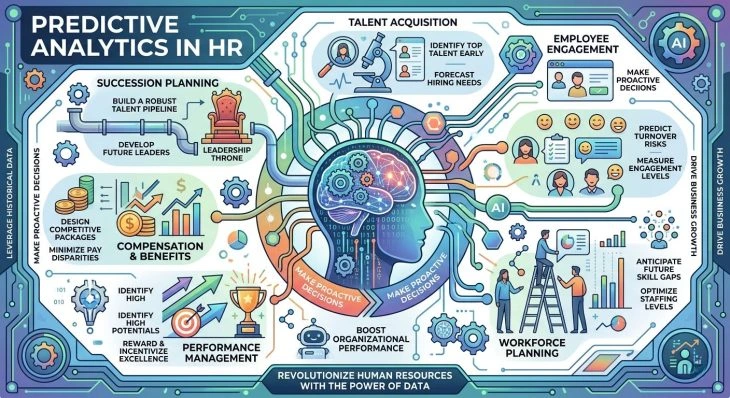
Employee turnover is one of the most expensive and overlooked challenges for businesses in Pakistan. Whether it’s a growing startup in Lahore or a corporate enterprise in Karachi, losing skilled employees disrupts operations, increases costs, and slows down growth.
In 2026, forward-thinking companies are no longer reacting to resignations they’re predicting them.
This shift is powered by AI-driven predictive analytics in HR, a technology that helps businesses identify employees who are likely to leave before they actually do.
This article explains how predictive analytics works, why it matters in Pakistan, and how companies can use it to reduce employee attrition effectively.
Predictive analytics in HR uses artificial intelligence and data analysis to forecast future employee behavior.
Instead of relying on guesswork, AI analyzes historical and real-time data to answer critical questions like:
This makes HR predictive analytics Pakistan one of the most powerful emerging search areas in HR technology.
Before diving into AI, it’s important to understand the impact of turnover:
Hiring and training new employees requires significant investment.
New hires take time to reach full productivity.
Experienced employees take valuable knowledge with them.
Frequent resignations affect morale and team stability.
For many Pakistani companies, these hidden costs go unnoticed but they directly impact profitability.
AI doesn’t rely on assumptions it uses data.
If an employee:
AI can flag them as a high attrition risk.
The system gathers employee data from HR systems, payroll, and attendance records.
AI identifies patterns linked to past resignations.
Each employee is assigned a risk score indicating the likelihood of leaving.
HR teams receive alerts and recommendations.
Companies using predictive analytics can:
This makes employee attrition AI Pakistan a high-value, future-driven keyword with strong ranking potential.
Instead of reacting to resignations, HR can:
By understanding why employees leave, companies can:
Decisions are based on real insights not assumptions.
Reducing turnover means:
AI helps companies:
Predictive systems often highlight these factors:
Employees seek better-paying opportunities.
No promotions or skill development.
Long hours and burnout.
Poor leadership leads to disengagement.
High demand for skilled talent.
AI helps quantify and prioritize these issues.
High turnover rates make predictive analytics essential.
AI helps manage frequent employee churn.
Large workforce data enables accurate predictions.
Even smaller companies benefit from early attrition insights.
| Factor | Traditional HR | AI Predictive Analytics |
|---|---|---|
| Decision Basis | Assumptions | Data-driven |
| Timing | Reactive | Proactive |
| Accuracy | Medium | High |
| Insight Depth | Limited | Advanced |
| Retention Impact | Low | High |
Incomplete data can affect predictions.
Many businesses are unaware of AI HR capabilities.
Traditional HR practices are deeply rooted.
Systems require proper integration and configuration.
By 2026 and beyond, predictive analytics will evolve into:
HR will shift from administrative to strategic and predictive.
Companies that adopt AI-driven HR insights:
In contrast, companies relying on manual HR processes will continue facing high turnover.
For businesses exploring HR predictive analytics Pakistan, it’s important to choose a platform that integrates all HR functions.
A strong system should include:
PayPeople.pk aligns with these requirements, helping businesses turn HR data into actionable insights.
Employee turnover is not just an HR issue it’s a business problem.
AI-powered predictive analytics gives Pakistani companies the ability to:
In 2026, the question is no longer whether to use AI in HR but how quickly businesses can adopt it.
Book a free demo, message us on WhatsApp +92 300 0800498, or email sales@paypeople.pk.