


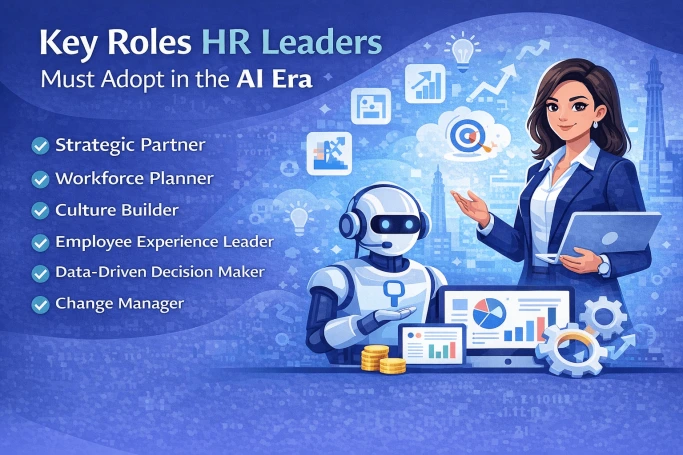
HR leaders must adopt new roles in the AI era because traditional administration is no longer enough. Businesses now need HR to drive strategy, use workforce data, improve employee experience, guide change, and support growth. AI handles many repetitive tasks, allowing HR leaders to focus on higher-value responsibilities that shape business success.
The workplace is changing fast. Businesses face new hiring demands, skill shortages, hybrid work models, and stronger employee expectations.
At the same time, AI is automating routine tasks such as reporting, payroll support, screening, and admin workflows.
This means HR leaders must move from task management to business leadership.
Modern HR leaders need to create value beyond administration.
HR leaders should work closely with leadership teams to align people strategy with business goals.
This includes:
Businesses need the right skills at the right time.
HR leaders should plan for:
Strong culture improves retention and performance.
HR leaders should shape:
Modern employees expect smooth systems and career growth.
HR leaders should improve:
HR decisions should be based on facts, not assumptions.
Leaders can use data for:
As companies adopt new systems and processes, HR leaders must guide employees through change with clear communication and training.
HR leaders should help choose and implement the right HR tools.
Modern systems can automate:
Platforms like PayPeople help connect these functions in one place.
AI does not replace HR leadership. It strengthens it.
AI can help by:
This allows HR leaders to focus where they create the most value.
Businesses in Pakistan are becoming more competitive across IT, retail, healthcare, education, manufacturing, and services.
Companies need HR leaders who can:
Organizations that modernize HR leadership may gain a clear advantage.
The next generation of HR leaders will be:
HR leadership is becoming one of the most important functions in modern organizations.
Key roles HR leaders must adopt in the AI era go far beyond administration. Today’s leaders must combine people expertise, technology, and business thinking. Companies that empower modern HR leadership will be better prepared for growth, change, and long-term success.
Book a free demo, message us on WhatsApp +92 300 0800498, or email sales@paypeople.pk.