

In many Pakistani companies, HR teams spend a large portion of their day answering the same questions repeatedly:
“How many leaves do I have left?”
“When will my salary be credited?”
“How do I apply for leave?”
“What is the company policy on late arrivals?”
These repetitive queries slow down HR productivity and frustrate employees who expect instant answers.
In 2026, businesses across Pakistan are solving this problem with AI-powered HR chatbots.
This article explains what an HR chatbot is, how it works, and why companies are rapidly adopting it to automate employee communication.
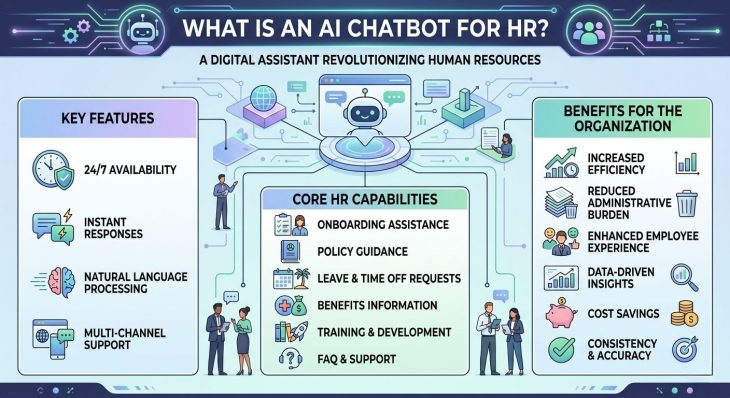
An AI HR chatbot is a virtual assistant that uses artificial intelligence to interact with employees and respond to HR-related queries in real time.
Unlike traditional help desks or HR emails, chatbots provide:
They act as a self-service HR system, reducing dependency on manual HR support. This is the same self-service concept behind AI Buddy, PayPeople’s own conversational HR assistant.
Search trends for “HR chatbot Pakistan” and “employee self-service AI Pakistan” are increasing because companies are facing:
1. Increasing Workforce Size As companies grow, HR teams struggle to handle employee queries efficiently.
2. Demand for Instant Communication Modern employees expect quick responses — waiting hours (or days) is no longer acceptable.
3. HR Workload Overload HR departments spend too much time on repetitive tasks instead of strategic work.
4. Shift Toward Automation Businesses are digitizing operations, and HR is no exception.
AI chatbots use technologies like:
Step-by-Step Functionality:
1. Leave Management Employees can check leave balance, apply for leave, and track approval status.
2. Payroll Queries Chatbots can answer questions on salary details, payslip requests, and deduction explanations.
3. Attendance Tracking Employees can check attendance records, view late marks, and request corrections.
4. HR Policy Access Instead of searching documents, employees can simply ask: “What is the dress code policy?” or “How many sick leaves are allowed?”
5. Employee Onboarding New hires can get instant guidance on company policies, documentation, and first-day instructions.
1. Massive Time Savings HR teams that adopt chatbots typically see a significant drop in repetitive queries reaching their inbox, freeing time for higher-value work such as talent development, employee engagement, and strategic planning.
2. 24/7 Employee Support Unlike HR staff, chatbots are always available — especially useful for remote teams, shift-based workers, and international operations.
3. Improved Employee Experience Employees get instant responses, no waiting time, and easy access to information, leading to higher satisfaction and engagement.
4. Consistency & Accuracy Human responses can vary, but chatbots provide standardized answers and accurate information from system data, reducing miscommunication.
5. Cost Efficiency Reducing manual HR workload means lower operational costs, better resource allocation, and higher productivity.
| Factor | Traditional HR | AI Chatbot |
|---|---|---|
| Response Time | Hours / Days | Instant |
| Availability | Limited | 24/7 |
| Scalability | Low | High |
| Consistency | Variable | High |
| Cost | Increasing | Optimized |
Imagine a company with 300 employees. Daily HR queries might include 50+ leave-related questions, 30+ payroll queries, and 20+ policy-related questions.
Without AI: HR spends hours responding manually.
With an AI chatbot, the large majority of routine questions — leave balances, payslip requests, policy lookups — get resolved instantly without HR involvement, and HR workload drops significantly.
HR chatbots are part of a larger shift toward employee self-service AI systems. This means employees can access their own data, perform HR actions independently, and get instant answers without HR involvement — reducing dependency and increasing efficiency across the organization.
1. Initial Setup Chatbots need proper integration with HR systems.
2. Data Accuracy Incorrect data leads to incorrect responses. Chatbots and predictive analytics both depend on the same thing — centralized, accurate employee data.
3. Employee Adoption Some employees may take time to trust and use AI systems.
By 2026 and beyond, HR chatbots will become even more advanced:
Companies using AI chatbots respond faster, operate more efficiently, and provide better employee experiences. In competitive industries, this directly impacts employee retention, productivity, and employer branding.
For businesses searching for HR chatbot Pakistan solutions, it’s important to choose a platform that integrates seamlessly with HR operations. A strong AI HR system should offer chatbot-based employee interaction, payroll and attendance integration, leave management automation, and real-time data access.
PayPeople.pk’s AI-driven approach aligns with these needs, enabling businesses to automate HR communication and reduce manual workload significantly.
AI chatbots are not replacing HR — they are empowering HR teams.
By automating repetitive tasks, chatbots allow HR professionals to focus on what truly matters: people, culture, and growth.
For Pakistani businesses in 2026, adopting HR chatbots is no longer optional — it’s a strategic move toward efficiency and scalability.
AI chatbots are not replacing HR — they are empowering HR teams.
By automating repetitive tasks, chatbots allow HR professionals to focus on what truly matters: people, culture, and growth.
For Pakistani businesses in 2026, adopting HR chatbots is no longer optional — it’s a strategic move toward efficiency and scalability.
Multilingual (Urdu + English) support is part of where these tools are heading, though coverage varies by platform today — confirm this with your vendor if it's a requirement.
A well-built chatbot only surfaces the data an employee is authorized to see (their own leave balance, their own payslip) — it doesn't open up company-wide HR records.
Setup time depends mostly on how clean and centralized your existing employee data is — a connected HRMS speeds this up considerably versus scattered spreadsheets.
No — it absorbs repetitive questions so HR staff can spend time on things a chatbot can't do: judgment calls, conflict resolution, and culture work.
