

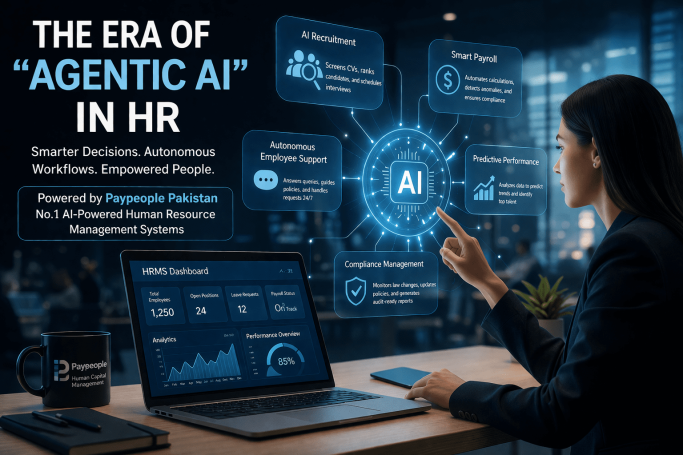
Human Resource Management Systems are entering a new era powered by Agentic AI. These systems no longer just automate tasks — they make decisions, execute workflows, and optimize HR operations on their own. This shift is helping organizations in Pakistan move from manual HR processes to intelligent, self-operating systems, resulting in less paperwork, fewer errors, and better workforce management. As HR technology matures, a modern HRMS is judged less by how many records it stores and more by how intelligently it acts on the data it holds.
Agentic AI in HR refers to AI systems that can act independently inside a Human Resource Management System. They analyze data, make decisions, and complete multi-step tasks without constant human input — reasoning through a situation and choosing the next step much like a capable employee would.
Unlike traditional automation, Agentic AI can:
In HR, this means a single system can validate a leave request, check policy compliance, update payroll, and notify a manager — all in one autonomous sequence. This is the foundation of what’s now called AI HRMS or Intelligent HR Systems.
Traditional HRMS platforms were built as digital filing cabinets: record keeping, fixed payroll formulas, and manual attendance tracking. Agentic AI is turning them into active decision-making engines.
Now, they are evolving into:
HR’s role is shifting from administrative processing to strategic oversight of Human Resource Software that thinks and acts on its own.
Traditional automation follows fixed if-then rules. AI assistants respond to prompts but still need human direction for each step. Agentic AI is different: it independently plans, decides, and executes multi-step HR workflows end-to-end with minimal supervision.
| Capability | Rule-Based Automation | AI Assistants | Agentic AI |
|---|---|---|---|
| Decision-making | Fixed if-then logic | Suggests options, human decides | Makes and executes decisions independently |
| Task scope | Single, isolated task | Single conversation/query | Multi-step, cross-system workflows |
| Learning | None — static rules | Limited, session-based | Continuously improves from outcomes |
| Human involvement | Required to set every rule | Required for each interaction | Required only for exceptions |
| HR Example | Auto-reject CVs missing a keyword | Chatbot answers “What’s my leave balance?” | Approves leave, updates payroll, notifies manager — automatically |
In short: rule-based systems execute what they’re told, assistants help people work faster, and Agentic AI actually does the job itself, within defined guardrails.
Agentic AI operates as a closed-loop workflow engine: it receives a trigger, evaluates it against policy and data, takes action, and records the outcome — no human needs to push the process forward manually.
Example — a leave request:
Employee submits leave → AI validates policy → checks leave balance → approves or escalates → updates payroll → notifies manager → stores compliance records.
This same trigger-validate-decide-act-record pattern applies to recruitment, attendance, performance reviews, and payroll — making Agentic AI the operational backbone of a modern AI HR Software stack.
Agentic AI adds five core capabilities to a modern HRMS:
Together, these shift HR software from a passive record-keeper into an active operational partner.
Companies in Lahore, Karachi, and Islamabad are adopting Agentic AI because manual HR can’t keep pace with growing, multi-location workforces. The value differs by size, but the core benefit — less manual effort, fewer errors, stronger compliance — is consistent:
Common adoption challenges in Pakistan include inconsistent internet infrastructure, limited digital literacy among older HR staff, and budget constraints for SMEs — which is why most companies start with payroll and attendance before expanding into recruitment and performance modules.
| Feature | Traditional HRMS | Agentic AI HRMS |
|---|---|---|
| Automation | Rule-based | Intelligent and adaptive |
| Decision Making | Human-dependent | AI-assisted or autonomous |
| Employee Support | Manual | AI-driven |
| Insights | Basic reports | Predictive analytics |
| Efficiency | Moderate | High |
Agentic AI introduces real value — but also new risk categories that simple automation never did:
The next phase moves beyond single-task automation toward interconnected AI agents that coordinate across HR functions:
The future of HR in Pakistan is automated, intelligent, and data-driven. Human Resource Management Systems powered by Agentic AI will become the standard for modern organizations — not a differentiator reserved for large enterprises, but an operational baseline.
Technology alone is not enough to transform HR. As AI becomes more autonomous, HR professionals must also evolve their leadership, decision-making, and workforce strategies. Learn about the key roles HR leaders must adopt in the AI era to prepare your organization for the next generation of AI-powered HR.
The rise of Agentic AI marks a turning point in HR. Human Resource Management Systems are no longer just tools — they are becoming intelligent partners in managing people and processes. For businesses in Pakistan, this means saving time, reducing errors, and scaling efficiently without scaling HR headcount at the same rate. The question is no longer whether to adopt AI in HR, but how fast you can implement it to stay ahead.
An AI system embedded in a Human Resource Management System that independently makes decisions and executes multi-step tasks, such as approving leave or flagging payroll anomalies, rather than only following fixed rules.
Traditional automation follows static if-then rules for single tasks. Agentic AI evaluates context, makes decisions, and completes entire workflows end-to-end, adapting as it learns from outcomes.
No. It handles routine, rule-defined decisions like leave approvals, but judgment-heavy decisions — terminations, culture initiatives, disciplinary matters — still require human oversight.
With encryption, role-based access, and regular security audits, Agentic AI systems can be as secure as any modern cloud HR platform.
It detects anomalies like duplicate entries or unusual overtime, applies compliance rules automatically, and syncs leave/attendance data directly into salary calculations.
Most start with a single high-volume function — payroll or attendance — then expand into recruitment and performance management once the system proves itself.
