


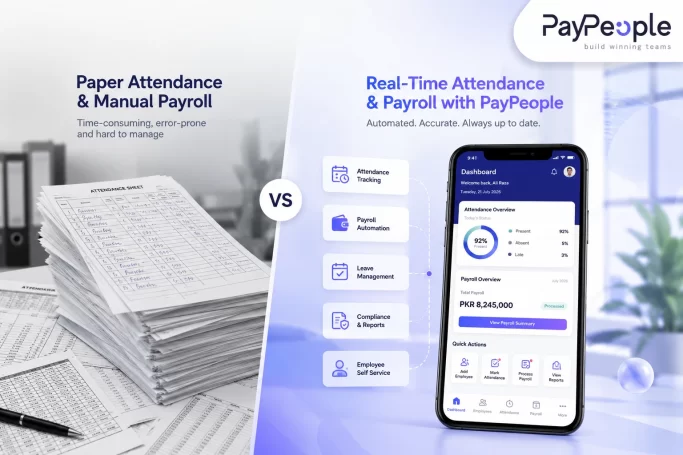
Managing payroll for 50 employees with spreadsheets is stressful. Managing it for 200 employees the same way is a liability. Errors compound, compliance gaps grow, and the HR team spends more time correcting records than supporting the people they’re supposed to serve.
An HRMS solves this — and adoption among Pakistani companies has grown sharply over the last three years. This guide explains exactly what an HRMS is, how it’s structured, and how to choose the right one.
An HRMS (Human Resource Management System) is software that centralizes and automates core HR functions — payroll, attendance, leave, recruitment, performance management, and employee records — on a single platform. Modern HRMS platforms are cloud-based, mobile-accessible, and increasingly powered by AI.
What is HRMS? HRMS stands for Human Resource Management System. It automates the full employee lifecycle — from hiring and onboarding to payroll processing and exit — so HR teams spend less time on admin and more time on people.
HRMS stands for Human Resource Management System — integrated software that manages the complete employee lifecycle from the first job application to final exit settlement.
The term appears alongside two others — HRIS and HCM — that most people use interchangeably. They’re related, but the distinctions matter when you’re deciding which system to buy.
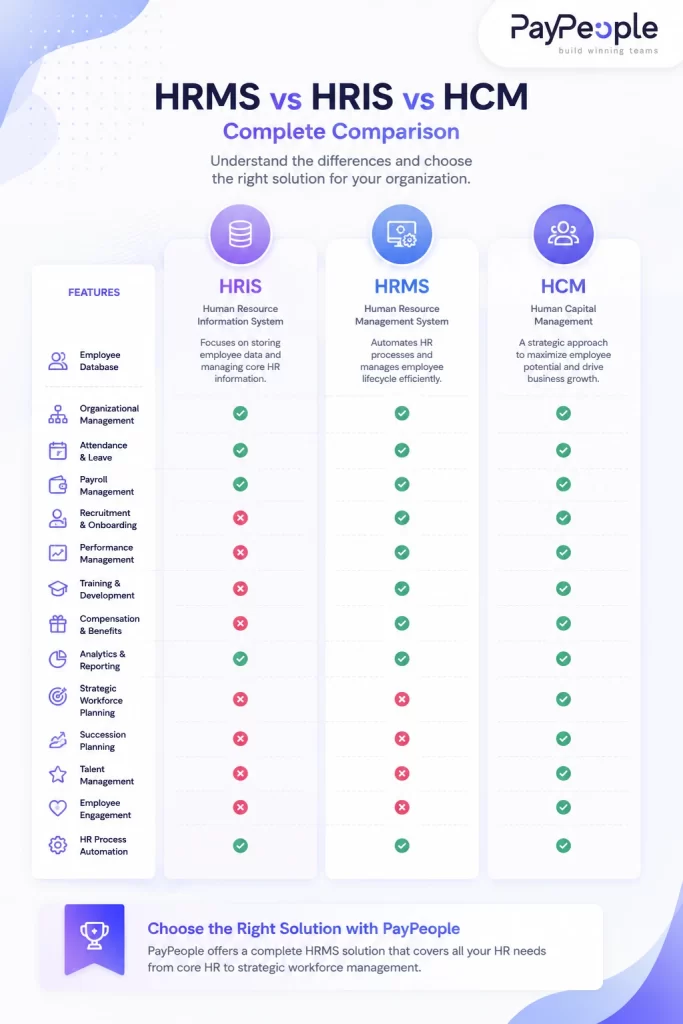
| Capability | HRIS | HRMS | HCM |
| Employee records and database | ✅ | ✅ | ✅ |
| Payroll processing | Partial | ✅ | ✅ |
| Attendance and leave management | ❌ | ✅ | ✅ |
| Recruitment and onboarding | Limited | ✅ | ✅ |
| Performance management | ❌ | ✅ | ✅ |
| HR analytics and reporting | Basic | ✅ | ✅ |
| Strategic workforce planning | ❌ | Limited | ✅ |
| AI-powered features | ❌ | ✅ (modern) | ✅ |
HRIS stores and reports on employee data. HRMS automates processes across the full HR lifecycle. HCM adds long-range talent strategy and workforce planning — tools built for enterprises with dedicated people-strategy teams.
For most Pakistani businesses — SMEs, mid-sized companies, and growing enterprises — an HRMS hits the right balance. Full HCM is more system than most operations need.
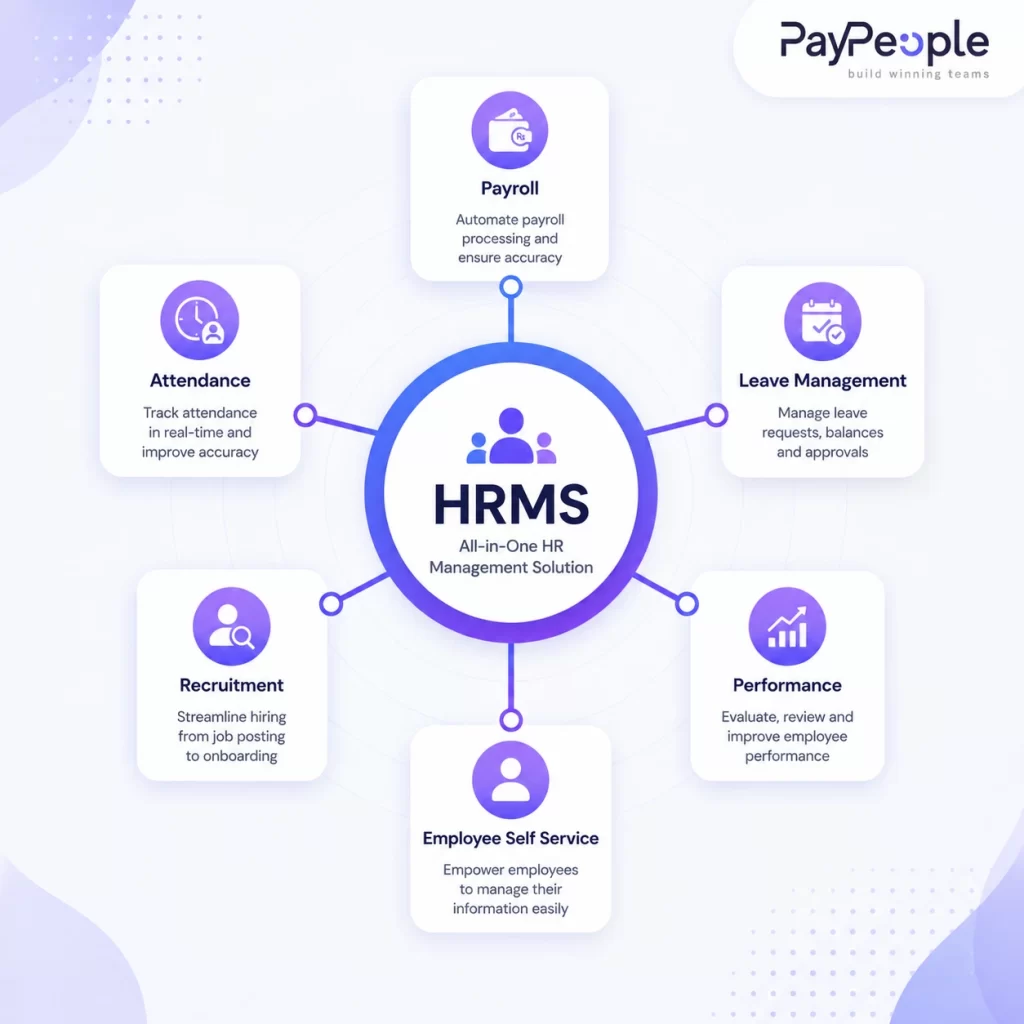
A full-featured HRMS covers these functional areas:
Employee Information Management Maintains employee records in a searchable central database — personal details, job history, contracts, and key documents. Every other module draws from this foundation, which means data quality here determines accuracy across payroll, compliance, and analytics.
Payroll Management Calculates salaries, overtime, deductions, taxes, and statutory contributions — including EOBI and PESSI where applicable. Generates payslips and payroll reports automatically at month-end.
Attendance Management Captures working hours through biometric devices, mobile apps, or GPS tracking. Syncs attendance data directly with payroll — which eliminates the manual entry that causes most payroll errors.
Leave Management Handles leave applications, approvals, balances, and accruals without email chains or paper forms. Leave data feeds automatically into the payroll run.
Recruitment Manages the full hiring process: job posting, applicant tracking, interview scheduling, and offer letters — all from one dashboard.
Performance Management Supports goal-setting, continuous feedback, formal appraisals, and performance-linked salary adjustments. Replaces the annual review that no one finds useful.
Employee Self-Service (ESS) Gives employees direct access to their payslips, leave balances, attendance records, and HR documents through a dedicated HRMS portal. Most companies see a 60–70% drop in routine HR queries after ESS goes live.
HR Analytics Real-time dashboards covering headcount, attrition, cost-per-hire, and attendance trends. Replaces the monthly Excel reports HR managers currently build manually.
Training and Development Tracks employee training programs, certifications, and skills-development progress. When connected to performance data, it links appraisal outcomes directly to learning plans — treating development and performance as one cycle rather than two separate admin tasks.
Benefits Administration Manages compensation beyond base salary — health insurance, allowances, retirement contributions, and other benefit programs. In Pakistan, this includes EOBI and PESSI calculations for eligible employees, handled automatically rather than manually each month.
An HRMS serves three groups — each using it differently:
HR Teams manage employee records, process payroll, track recruitment, run compliance reports, and handle day-to-day HR operations. Most of the admin that used to sit in spreadsheets and email threads moves into the system.
Line Managers approve leave requests, monitor attendance, run performance evaluations, and pull team reports — without routing every question through HR. This is where the biggest operational time savings appear. When managers can do this themselves, HR isn’t the bottleneck.
Employees access payslips, submit leave requests, update personal details, and view company policies through the self-service portal. Not having to contact HR for routine information is a change most employees notice — and appreciate — within the first week.
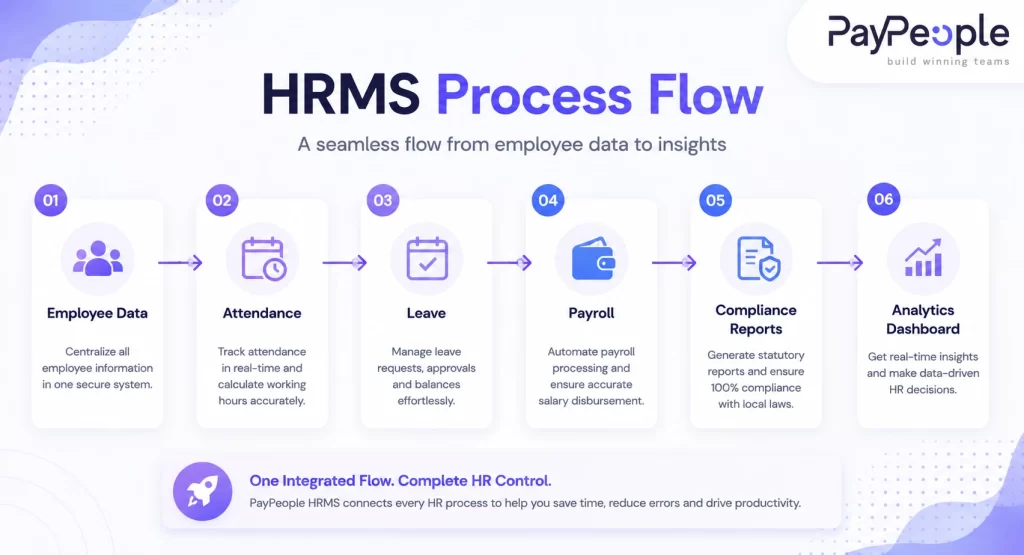
The workflow follows a clear operational sequence:
A payroll process that takes a 3-person HR team 4–5 days typically runs in 4–6 hours on an HRMS. That’s not a marginal improvement — it’s a structural one.
Real-World Example A manufacturing company in Karachi with 150 employees used to process payroll manually — attendance registers collected by hand from supervisors, totaled by the payroll officer, entered into spreadsheets, then checked for errors before accounts received them. The cycle ran 5–6 working days and still produced mistakes.
After implementing an HRMS: biometric devices capture attendance automatically, leave is approved through the system, and payroll completes in under two hours on the last working day of the month. Payslips reach employees’ phones the same afternoon. Five days became half a day.
Three factors are driving HRMS adoption among Pakistani businesses right now:
Compliance requirements have tightened. FBR payroll reporting, EOBI contributions for all eligible employees, and PESSI requirements in Punjab and Sindh are now enforced more consistently than they were five years ago. Manual records don’t hold up in audits. If you’re unsure whether adopting an HRMS is a legal requirement for your business, the HRMS legal compliance guide for Pakistan covers the regulatory obligations in detail.
Remote and hybrid teams need digital infrastructure. A company with offices in Karachi, Lahore, and Islamabad can’t rely on paper attendance registers or a payroll officer in one city processing records from another. Cloud HRMS platforms make distributed workforce management practical rather than chaotic.
AI is now in the tools. Smart attendance anomaly detection, attrition risk scoring, and automated CV screening are available in mid-market HRMS platforms — not just enterprise suites. Pakistani companies are starting to use these features to compete for talent.
PayPeople, developed by Bilytica, is a cloud HRMS built for Pakistan’s environment — supporting EOBI, PESSI, and FBR compliance out of the box alongside AI-powered HR analytics.
| Benefit | What Changes in Practice |
| Fewer payroll errors | Automated calculations eliminate manual input mistakes |
| Time recovered | HR teams typically save 15–20 hours per week on admin |
| Compliance accuracy | Statutory reports generated automatically, audit-ready |
| Better employee experience | ESS portals clear routine HR query backlogs |
| Faster decisions | Real-time dashboards replace end-of-month spreadsheets |
| Scale without adding headcount | Add employees and locations without growing the HR team |
Most failed HRMS rollouts trace back to the same patterns. Here’s what to watch for:
Dirty data going into a clean system. If your existing employee records have inconsistent naming, duplicate entries, or outdated salary structures, the HRMS doesn’t fix that — it automates it. Data cleansing before migration isn’t optional.
Buying for features you won’t use. A platform with 40 modules your team will never touch is harder to adopt than one with 12 that match your actual workflow. Over-specification is one of the most common buying mistakes Pakistani HR teams make.
Not training line managers. HR teams adopt the system. Managers go back to WhatsApp for attendance approvals and leave sign-offs. Adoption without manager buy-in kills the process automation the system was supposed to deliver.
Choosing a global platform without local compliance configuration. A system not set up for EOBI, PESSI, or provincial labor laws creates compliance gaps on day one — regardless of how polished the interface is.
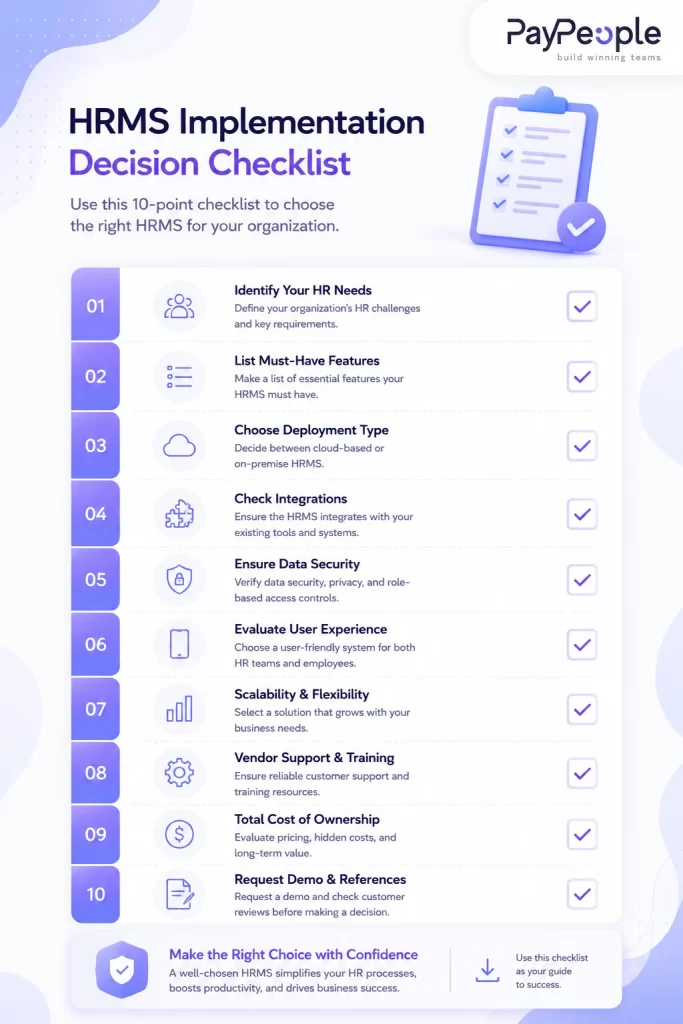
Run through this before signing a contract:
An HRMS is not a tool reserved for large enterprises. For any Pakistani business managing 30 or more employees — where payroll errors, attendance disputes, or compliance gaps are already costing time and money — it’s the operational foundation that makes accurate payroll, legal compliance, and data-driven HR decisions possible.
The right HRMS also gives HR teams back something they almost never have: time to focus on the people side of the job.
PayPeople is a cloud-based HRMS built for Pakistani businesses, covering payroll, attendance, leave, recruitment, performance management, Employee Self-Service, and AI-powered HR analytics. Request a free demo to see how it handles your specific workforce requirements.