


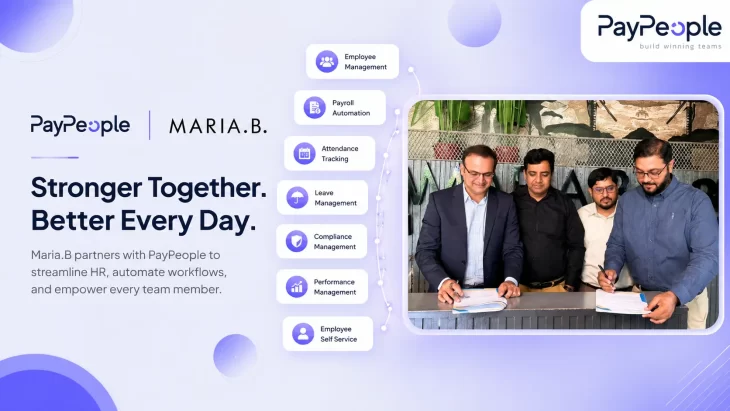
Direct Answer: Yes — Maria.B Designs (Pvt.) Ltd. has been onboarded as a client by PayPeople, a cloud-based HR and payroll software provider in Pakistan. According to PayPeople’s official announcement, the collaboration centers on AI-powered payroll automation, attendance management, and centralized workforce data for the Pakistani fashion brand. The move reflects a broader shift among large fashion and retail companies in Pakistan away from manual, spreadsheet-driven HR processes and toward cloud-based systems.
Executive Summary
Maria.B. Designs (Pvt.) Ltd., one of Pakistan’s well-known fashion brands, has been onboarded as a client by PayPeople, a cloud-based HR and payroll software provider based in Pakistan. The announcement, shared on PayPeople’s official LinkedIn page, describes Maria.B as embracing smarter, AI-powered HR and payroll transformation through the collaboration. The move reflects a broader pattern among large retail and fashion organizations in Pakistan: replacing manual, spreadsheet-driven HR processes with centralized, cloud-based systems that can handle payroll, attendance, leave, and workforce reporting at scale.
Human resource management in Pakistan is going through a quiet but steady shift. For years, HR teams at large companies relied on spreadsheets, paper attendance registers, and manual payroll calculations. That approach worked when a company had a few dozen employees working from one office. It breaks down quickly once a business operates multiple retail outlets, manufacturing units, or warehouses spread across cities, each with its own shift patterns and staffing needs.
HR digital transformation refers to this shift away from manual, paper-based HR processes toward centralized software systems that handle payroll, attendance, leave, recruitment, and performance data in one place. For enterprises, this isn’t a cosmetic upgrade. It’s a practical response to the reality that manual processes don’t scale, and errors in payroll or attendance at scale translate directly into cost, compliance risk, and employee dissatisfaction.
Large fashion and retail brands are a good example of why scalable HR systems matter. These businesses typically run several outlets, seasonal staffing changes, and a workforce that includes retail staff, tailoring and production teams, warehouse workers, and corporate office employees — all with different attendance and payroll rules. Managing this manually means HR teams spend most of their time on repetitive administrative work instead of strategic workforce planning.
It’s in this context that PayPeople has announced Maria.B. Designs (Pvt.) Ltd., a recognized name in Pakistan’s fashion retail sector, as its newest client. The announcement, shared through PayPeople’s official LinkedIn channel, frames the collaboration around intelligent workforce management, seamless payroll operations, and enhanced employee experiences — signaling Maria.B’s move toward a centralized, cloud-based HR system.
Maria.B, formally registered as Maria.B. Designs (Pvt.) Ltd., is a Pakistani fashion brand known for its clothing collections, retail presence, and consumer following across Pakistan. Like most large fashion retailers, Maria.B operates a workforce that spans retail floor staff, design and production teams, warehousing, and corporate functions — a combination that makes workforce management more complex than a typical single-location business.
PayPeople is a cloud-based HR and payroll software platform built for businesses operating in Pakistan. The platform covers payroll processing, attendance tracking, leave management, recruitment, performance management, employee self-service, and HR reporting, with compliance features aligned to Pakistani labor and tax regulations.
PayPeople is developed and supported by Bilytica, a global technology company that delivers enterprise software and digital transformation solutions across multiple industries. That backing gives PayPeople access to broader enterprise software engineering practices beyond a standalone HR tool.
Modern HR software matters for large enterprises because manual systems don’t scale with headcount, locations, or complexity. Once a business crosses a certain size, spreadsheets and paper records become a liability rather than a convenience. A single payroll error, a missed compliance deadline, or an attendance discrepancy can cascade into bigger operational and legal problems.
Enterprises typically need:
This is why enterprise HR software and cloud HR software have become close to standard for organizations operating at scale, rather than a discretionary upgrade.
According to PayPeople’s announcement, Maria.B was onboarded as a client to support its shift toward AI-powered HR and payroll operations, with the collaboration centered on intelligent workforce management, streamlined payroll, and improved employee experience. While the specific commercial terms haven’t been publicly detailed, the decision fits a pattern common among large retail and fashion businesses: moving from manual or fragmented systems to a single cloud-based platform that can handle payroll, attendance, and workforce reporting without stitching together separate tools.
For a business like Maria.B, with a workforce spread across retail, production, and corporate functions, a unified HR and payroll platform reduces the operational overhead of maintaining separate processes for each employee category.
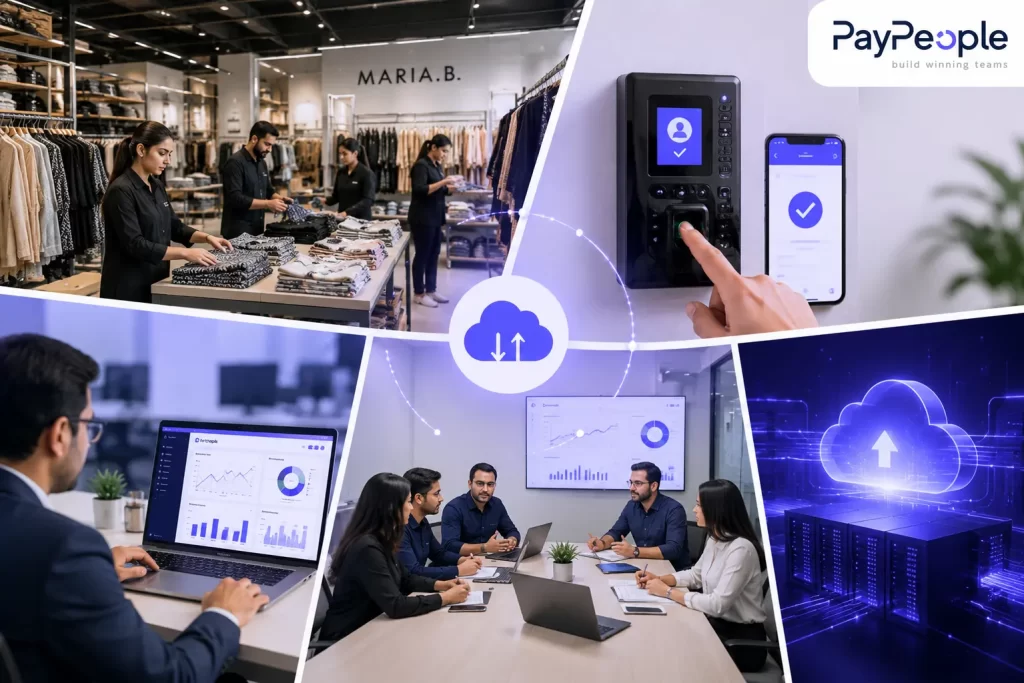
Large fashion and retail brands face a recurring set of HR problems tied to scale: multi-location attendance, payroll accuracy, shift complexity, and compliance. Understanding these challenges explains why platforms like PayPeople exist in the first place.
Large fashion retailers employ staff across many outlets and departments — sales staff, tailors, warehouse workers, designers, and corporate teams. Keeping accurate, centralized records for a workforce this varied is difficult without a dedicated system.
Payroll for a retail-heavy workforce often involves variable shifts, incentives, and deductions. Manual payroll calculation increases the risk of errors, which directly affects employee trust and satisfaction.
With multiple outlets, attendance tracking needs to work consistently across locations — often through biometric devices or mobile check-ins — and feed directly into payroll without manual re-entry.
Retail and production staff frequently work rotating or seasonal shifts. Coordinating this manually across many outlets is time-consuming and prone to scheduling conflicts.
Tracking leave balances, approvals, and policy compliance across a large and distributed workforce is difficult to do accurately without a centralized system.
Pakistani labor law and tax regulations apply differently depending on employee category and location. Non-compliance carries financial and legal risk, making automated compliance tracking valuable for large employers.
When employees can’t independently check payslips, apply for leave, or update their information, HR teams get buried in repetitive requests instead of focusing on higher-value work.
Without centralized data, it’s difficult for HR and leadership to get a clear, real-time picture of workforce costs, attendance patterns, or turnover — data that matters for planning and decision-making.
PayPeople’s platform is designed to address the operational challenges described above through a single connected system rather than separate manual processes. For a large fashion retailer like Maria.B, the parts of the platform most relevant to day-to-day HR operations include:
Payroll and Attendance — Payroll management works together with attendance tracking, including biometric integration, so salaries are calculated from actual attendance and shift data rather than manual entry.
Shifts and Leave Management — Rotating and seasonal shift patterns, common in retail and production teams, are handled alongside leave requests and approvals in the same system.
Employee Self-Service — Staff can check payslips, apply for leave, and view attendance through the platform’s self-service portal and mobile app, without routing routine requests through HR.
Recruitment and Performance — Hiring, onboarding, and performance reviews are managed centrally, which matters for a business hiring across multiple outlets and departments.
Reporting and Analytics — Centralized dashboards give HR and leadership visibility into attendance, payroll, and workforce trends without manual report-building.
Beyond these core areas, PayPeople’s broader platform also covers company setup, document management, task and event coordination, and asset tracking — the kind of administrative groundwork that supports a growing, multi-location workforce. PayPeople also provides customer support Monday to Friday, 9 a.m. to 7 p.m., for platform-related queries.
Employees gain direct access to their own HR information — payslips, leave balances, and attendance records — without waiting on HR staff for routine requests.
HR staff spend less time on repetitive administrative tasks and gain a centralized system for managing a large and distributed workforce, freeing time for higher-value work like workforce planning.
Leadership gets clearer visibility into workforce costs and trends through centralized reporting, supporting more informed decisions about staffing and operations.
For Maria.B, adopting a cloud-based HR and payroll system is a practical operational decision, not a symbolic one. The collaboration represents a step toward standardizing HR operations across a workforce that spans retail, production, and corporate functions, with the value showing up in fewer payroll errors, faster HR processes, and better workforce visibility over time.
Onboarding a recognized fashion retail brand strengthens PayPeople’s presence in Pakistan’s retail and fashion sector specifically, alongside its existing work with businesses across other industries. This collaboration reflects the kind of enterprise-scale use case that cloud HR platforms are built for.
Digital HR transformation is likely to continue expanding among mid-size and large Pakistani businesses, driven less by trend and more by the practical limits of manual HR management at scale. As more retail, manufacturing, and corporate organizations grow their workforces across multiple locations, centralized HR and payroll systems become less of an option and more of an operational necessity.
Maria.B has been onboarded by PayPeople as its HR and payroll technology partner, a move that fits the broader pattern of large Pakistani retail and fashion businesses adopting cloud-based HR systems to manage payroll, attendance, and workforce data at scale. The collaboration reflects the operational realities of running a multi-location retail and production workforce, where manual HR processes create more problems than they solve.