


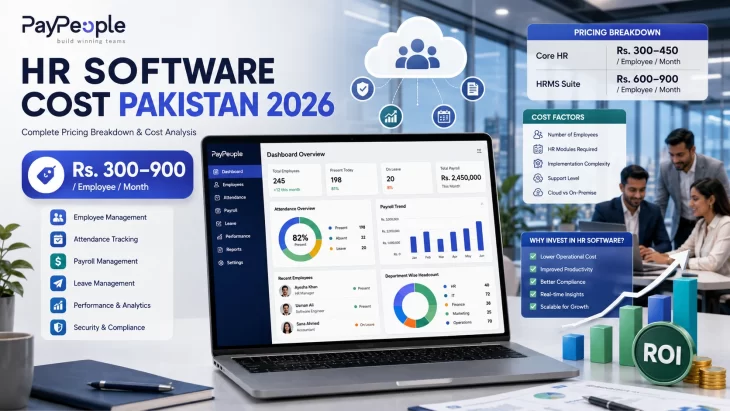
Quick answer: Cloud-based HR software cost in Pakistan typically costs Rs. 300–900 per employee per month, depending on which modules you need — core HR and employee records sit at the low end, a full HRMS suite with performance management and workflow automation sits at the high end. On top of the subscription, budget for one-time setup and data migration costs, which vary by how clean your existing records are. Most Pakistani SMEs recover this cost within a few payroll cycles through reduced errors and admin time — see the ROI breakdown below.
Four factors move the price more than anything else: company size (per-employee pricing means headcount is the biggest lever), module count (core HR alone costs far less than a suite with performance management and workflow automation), implementation complexity (a clean 30-person startup migration is not the same job as untangling five years of spreadsheet history for a 400-person manufacturer), and support tier (basic email support vs. a dedicated local account manager who’s reachable before the FBR/EOBI 15th-of-the-month deadlines).
Company size and module count are the two that matter most when you’re first building a budget — everything else is a smaller adjustment on top.
| Module | Self-Service Included | Workflow Automation | Price (PKR/employee/month) |
| Core HR & Employee Vault | Yes | Basic | Rs. 300 – 450 |
| Leave & Expense Management | Yes | Advanced | Rs. 400 – 600 |
| Performance & Appraisals | Partial | Standard | Rs. 350 – 550 |
| Full HRMS Suite (all modules) | Yes | Custom | Rs. 600 – 900 |
These ranges are for cloud-based (SaaS) pricing, which is what most new deployments in Pakistan use in 2026. Vendors typically quote per-employee-per-month rates with a minimum seat count, so a very small team (under 10 people) may see a flat minimum fee rather than the pure per-head rate.
Licensing fees. The recurring subscription cost, billed monthly or annually. Cloud-based pricing (the table above) is now the default for most Pakistani businesses because it avoids the upfront hardware spend of on-premise systems.
Implementation and configuration. Setting up your organizational structure, leave policies, approval chains, and tax rules to match your company. For a straightforward SME rollout this is usually bundled into onboarding; for larger or multi-branch companies with custom workflow needs, expect this to be quoted separately.
Data migration. Moving employee records, historical payroll, and leave balances from Excel or a legacy system into the new platform. Cost here tracks directly with how clean your existing data is — see the note on this in the mistakes section below.
Training. Getting HR staff, managers, and employees comfortable with the new system. Underbudgeting training is one of the most common reasons a rollout stalls after go-live.
Support and maintenance. With cloud-based systems this is usually bundled into the subscription; confirm what’s included (email-only vs. WhatsApp/phone) versus what’s a paid add-on.
These don’t show up on a vendor’s price sheet, but they’re real:
| Factor | Cloud (SaaS) | On-Premise |
| Upfront cost | Low — subscription-based | Higher — hardware + licensing |
| Maintenance | Handled by vendor | Handled by your IT team |
| Access | Any device, anywhere | Typically office-network only |
| Updates | Automatic | Manual, scheduled by IT |
| Typical fit | Most SMEs and mid-market companies | Some government bodies, highly regulated industries |
For most private-sector businesses in Pakistan, cloud is the practical default in 2026 — lower upfront cost and no server maintenance burden. Public sector and highly regulated organizations sometimes have a specific data-residency requirement that points toward on-premise or a hybrid setup; see our public sector HR software guide if that applies to you.
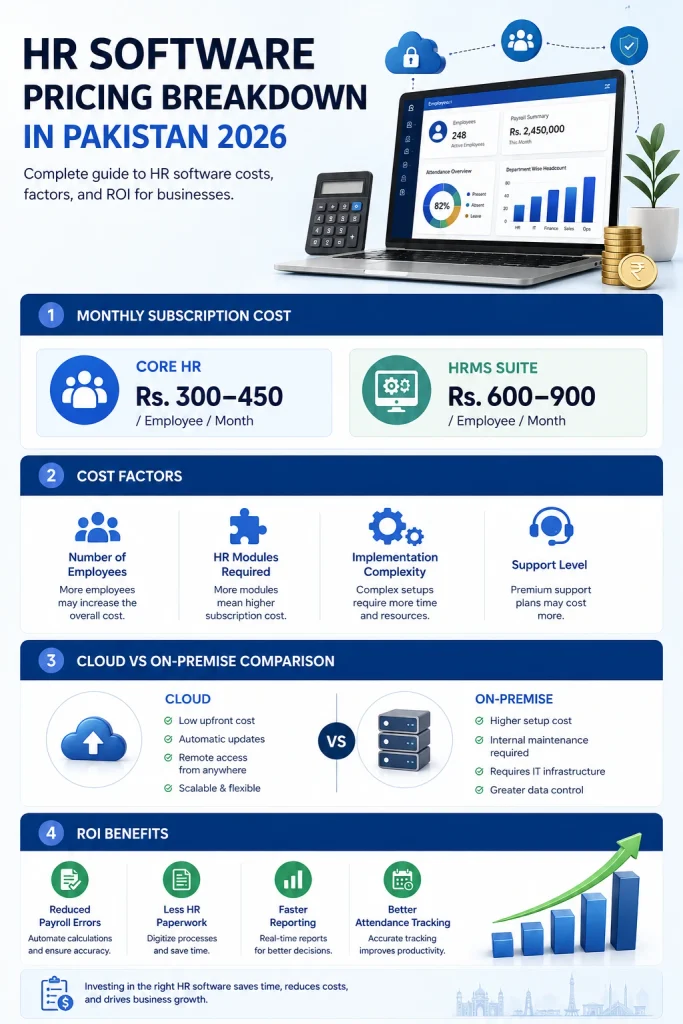
The subscription cost is easy to see. The return is less visible but generally larger over a year:
There’s no single fixed payback period that applies to every company — it depends heavily on current headcount and how manual your existing process is. As a directional guide: the companies that see the fastest payback are the ones already experiencing the operational pain points described in our enterprise HR guide — payroll taking more than a day to run, or a recent compliance near-miss.
Evaluating HR software for your business? See our complete buyer’s guide for the full feature and vendor-comparison framework, or book a free demo to get exact pricing for your team size.
Cloud-based HR software in Pakistan typically starts around Rs. 300–450 per employee per month for core HR, rising to Rs. 600–900 for a full HRMS suite with performance management and workflow automation. Exact pricing depends on company size and which modules you need.
Most cloud HRMS vendors in Pakistan price per employee per month, though some apply a minimum monthly fee for very small teams. Confirm both numbers before comparing quotes across vendors.
This varies by vendor and by module tier — don’t assume it’s included. Ask specifically whether EOBI wage-ceiling calculation and current FBR tax slabs are part of your quoted package, and ask for a live demo rather than accepting the claim at face value. See our HR compliance guide for what correct compliance handling actually requires.
For most SMEs and mid-market companies, yes — cloud avoids the hardware, server maintenance, and in-house IT costs that on-premise systems carry. On-premise can still make sense for organizations with a specific data-residency requirement.
This depends heavily on data cleanliness and company size — a straightforward SME migration is often bundled into onboarding, while multi-branch or highly customized rollouts are typically quoted separately. Budget extra time (not just money) if your existing records need cleanup before migration.
There’s no fixed number — it depends on your current headcount and how manual your existing process is. Companies already experiencing frequent payroll errors, compliance near-misses, or HR teams overwhelmed by manual requests tend to see the fastest payback.