


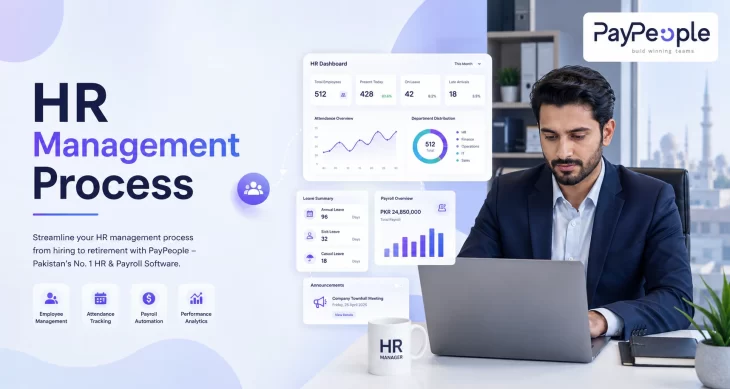
The HR management process is the structured sequence HR teams follow to manage employees from hiring to exit: workforce planning, recruitment, onboarding, attendance and leave, payroll and compliance, performance management, employee self-service, and offboarding. In Pakistan, this process also has to satisfy EOBI, PESSI/SESSI, and FBR withholding rules at the payroll stage — a layer most generic HR guides skip entirely.
| Element | Detail |
| Core stages | 8 (planning to offboarding) |
| Pakistan-specific compliance bodies | FBR, EOBI, PESSI/SESSI, Labor Courts |
| Manual process failure point | Payroll and leave tracking (highest error rate) |
| Typical HRMS payback | Reduced processing time, fewer compliance penalties |
| Who this is for | Founders, HR managers, and finance leads in Pakistani SMEs and enterprises |
The HR management process is the end-to-end system a company uses to manage its people — from planning what roles it needs, through hiring, developing, paying, and eventually parting ways with employees. It exists so that every employee interaction, from a job offer to a final settlement, follows a consistent, auditable standard rather than depending on one HR person’s memory.
A mature process does three things at once: it protects the business legally, it gives employees a predictable experience, and it produces the data leadership needs to plan headcount and cost. When any one of those breaks — say, leave records live in three different spreadsheets — the other two usually break with it.
Most HR process guides are written for the US or UK market and stop at “compensation and benefits.” That’s not enough for a business operating here. Pakistani employers sit inside overlapping regulatory layers, and each one touches a different stage of the HR process:
None of this is optional, and none of it is exempted by company size. A five-person startup and a 500-person enterprise both owe EOBI and PESSI contributions. This is the layer a generic “7 HR processes” article misses — and it’s exactly why HR software built for Pakistan, rather than adapted from a US template, matters at the payroll and compliance stage.
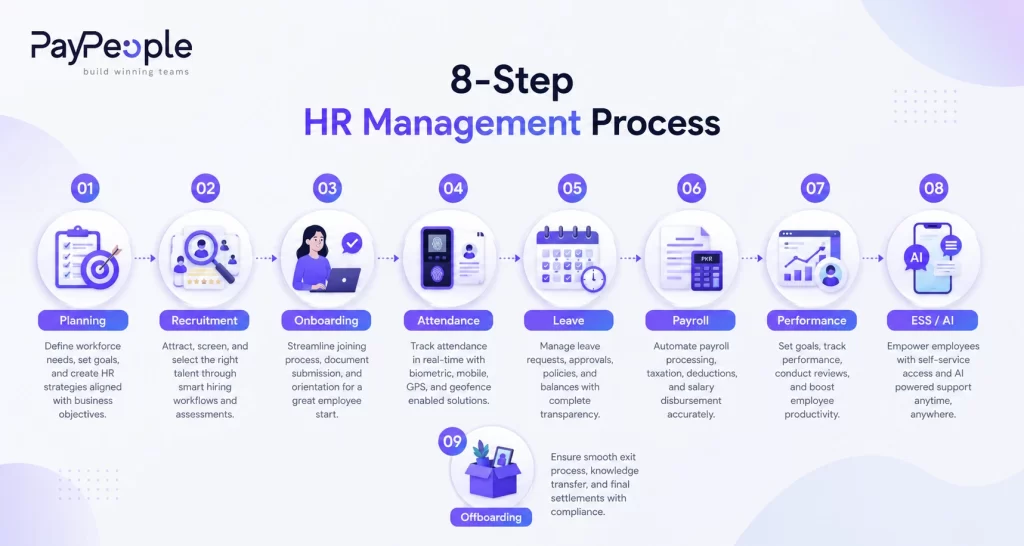
Before posting a job, HR should confirm headcount is actually justified against budget and business goals — not just backfilling a resignation. Recruitment then covers writing the job description, sourcing candidates (LinkedIn, Rozee.pk, referrals), screening with an Applicant Tracking System, and structured interviews. A defined recruitment workflow shortens time-to-hire and reduces the cost of a bad hire, which studies consistently show is one of the most expensive and avoidable HR failures.
Onboarding starts the day an offer is accepted, not the first day of work. Pre-boarding (contract, documents, system access), a first-day agenda, a 30-60-90 day plan, and an assigned buddy or manager check-in all reduce early attrition — new hires who go through structured onboarding are measurably more likely to stay past year one.
Accurate attendance is the input every downstream process depends on: payroll, overtime, leave balances, and performance data all trace back to it. Biometric or app-based attendance tracking removes the manual register and the disputes that come with it, and feeds clean data straight into payroll.
Leave in Pakistan isn’t one policy — annual, casual, sick, maternity, and Hajj leave each carry different entitlements, and some vary by province. Leave has to be tracked by type, approved through a clear workflow, and reconciled against attendance so payroll never has to guess. This is exactly what a leave management system is built to handle.
This is the highest-risk stage. Payroll software built for Pakistani compliance must calculate gross-to-net pay, apply FBR withholding tax correctly, deduct and remit EOBI and PESSI/SESSI contributions, and produce a compliant payslip (name, designation, pay period, gross pay, itemized deductions). Manual payroll is where most compliance failures originate — a missed EOBI filing or an incorrect tax slab can trigger penalties well beyond the cost of the error itself.
Setting goals (KPIs or OKRs), running regular check-ins rather than a single annual review, and using structured or 360-degree feedback keeps performance management from becoming a once-a-year formality. The goal is a documented, fair basis for raises, promotions, and — when necessary — performance improvement plans.
This is the stage most 2026 guides still leave out entirely. Employee self-service through a mobile app lets employees apply for leave, view payslips, and update records themselves, cutting routine requests to HR. Layered on top, AI HR agents now handle first-draft job descriptions, screening summaries, attendance-anomaly flags, and turnover-risk signals — freeing HR to focus on judgment calls rather than paperwork.
A structured exit covers access revocation, asset return, a documented exit interview, and final settlement calculated correctly against notice period, leave encashment, and any EOBI/PESSI adjustments. Handled well, offboarding protects the employer brand and surfaces honest feedback that the recruitment stage above rarely gets.
Once you understand the complete HR management process, many organizations choose to automate these HR processes using an HRMS to manage recruitment, attendance, payroll, leave, and performance more efficiently.
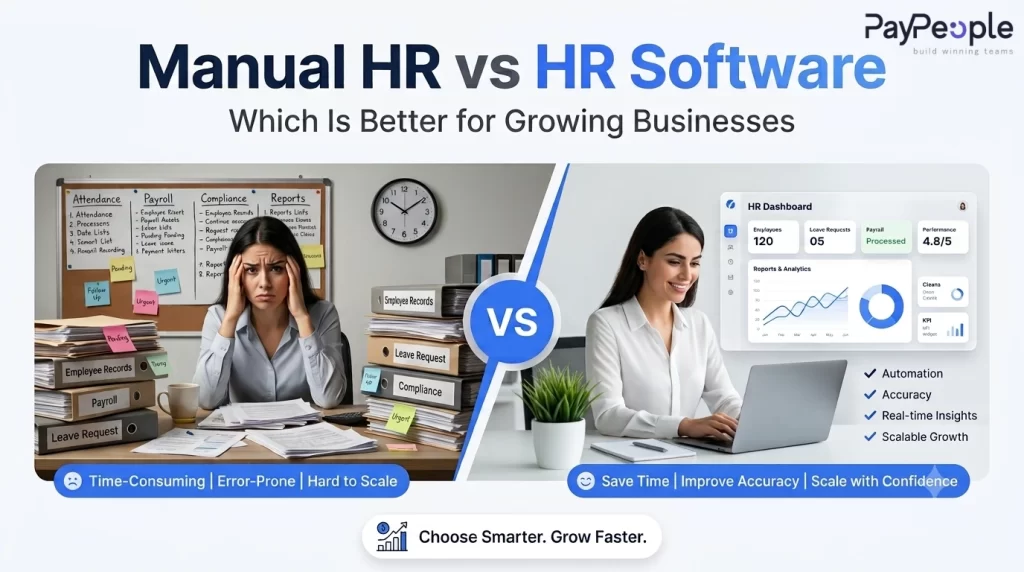
| Factor | Manual / Spreadsheet HR | HRMS Software (e.g., PayPeople) |
| Payroll accuracy | Manual formulas, error-prone | Automated FBR, EOBI, PESSI calculations |
| Leave tracking | Scattered across sheets/email | Centralized, policy-based, auto-reconciled with attendance |
| Compliance reporting | Rebuilt manually each audit | Generated on demand, audit-ready |
| Employee experience | HR handles every request | Self-service via ESS portal/app |
| Data for decisions | Static, backward-looking | Real-time dashboards and analytics |
| Multi-province operations | Separate manual tracking per province | Single system with province-specific rules built in |
Consider moving from manual processes to HR software when any of these are true:
The HR management process isn’t just a hiring-to-exit checklist — in Pakistan, it’s a compliance system with people management built on top of it. Getting workforce planning, onboarding, attendance, and performance right matters, but the process only holds up if payroll and statutory compliance are handled correctly every single month. That’s the stage where manual systems fail first, and it’s exactly where purpose-built HR software like PayPeople’s HRMS, payroll, attendance, leave management, and employee self-service platform removes the risk.
Call to Action: Ready to see how PayPeople handles the full HR process — recruitment through payroll compliance — for your team? Book a free demo and see it running on your own payroll data.